Pioneer Squirrel Girl Combo
The deck
Pioneer, 27 Sep – 24 Nov 2026
Squirrel Girl Combo

- Decks:
- 4
- Window:
- 27 Sep – 24 Nov 2026
- Events:
- 2
- Format:
- Pioneer
- W-L-D:
- 6–6–0
- Matches:
- 12
Share
32nd by share, 0.3%
Share by week, 0.0% to 8.5%
Down 4.0 pp vs. the 60 days before
Win rate
50.0%
95% range 25.4 to 74.6%
Down 6.4 pp vs. the 60 days before
Slots settled
61.8 of 75Locked
Still argued over
13.2 of 75
Stock list
- 4 copies in every list
- 4 copies in 1 list out of 4
- 1 copy in every list
- always 1 copy, sometimes 2
- Solid: 80% of lists or more.Hatched: fewer. The fill is the share.
Maindeck60 slots
Settled core16 cards · 56.5 slots
Still argued over7 cards · 3.5 slots
Sideboard15 slots
Settled core3 cards · 5.2 slots
Still argued over14 cards · 9.8 slots
The lists people registered
- #17PuffSunNRG Series: Magic $2.5k Pioneer Trial · 22 Nov
- #33Aje8NRG Series: Magic $2.5k Pioneer Trial · 22 Nov
- #49TurnPikeBearNRG Series: Magic $2.5k Pioneer Trial · 22 Nov
- 5–0CliffBoyardeePioneer League · 29 Oct
Show decklist for PuffSun
Squirrel Girl Combo
Open at tournamentDownloadImageWideTall
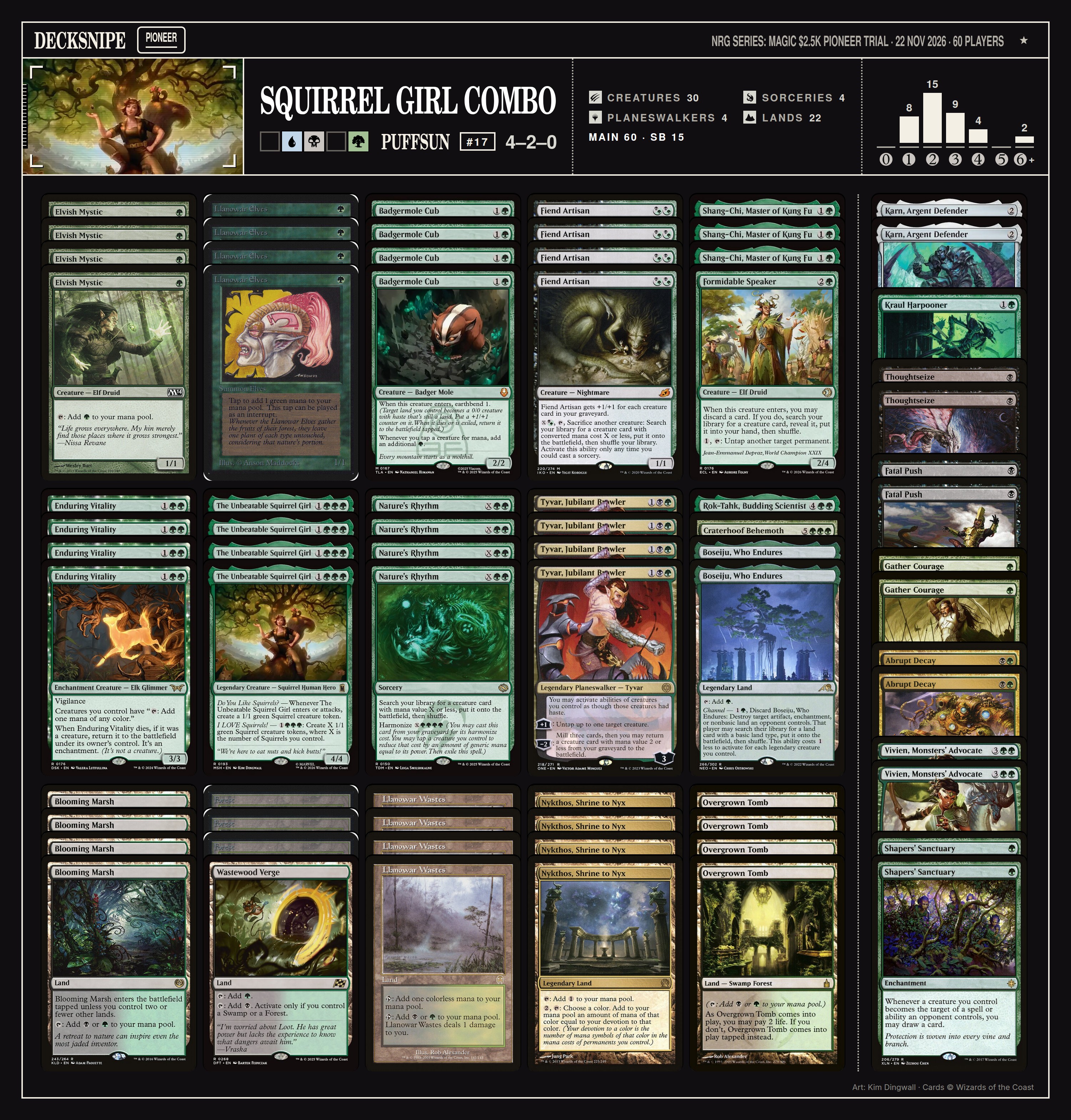
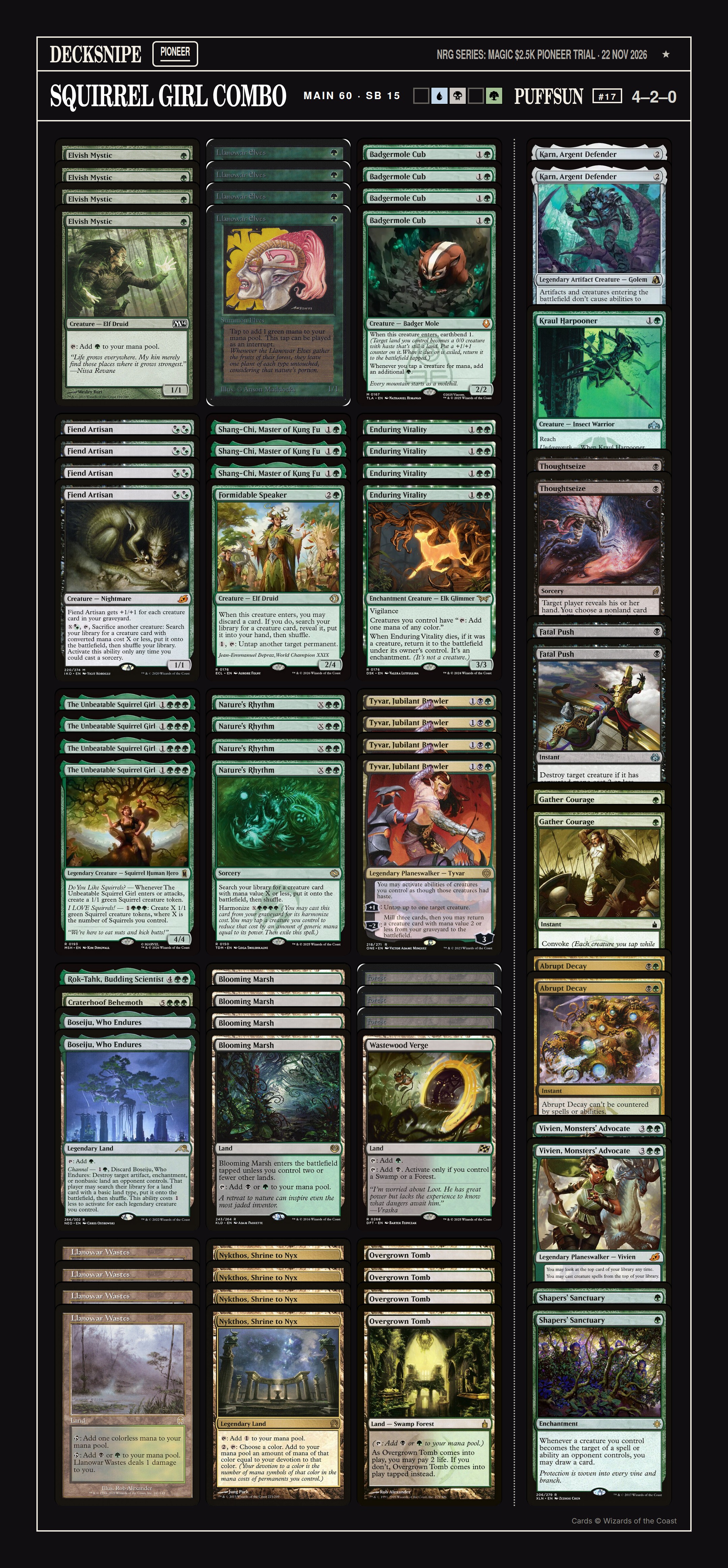
Maindeck (60)
Creatures 30
Sorceries 4
Planeswalkers 4
Lands 22
Sideboard (15)
75 cards
Show decklist for Aje8
Squirrel Girl Combo
Open at tournamentDownloadImageWideTall
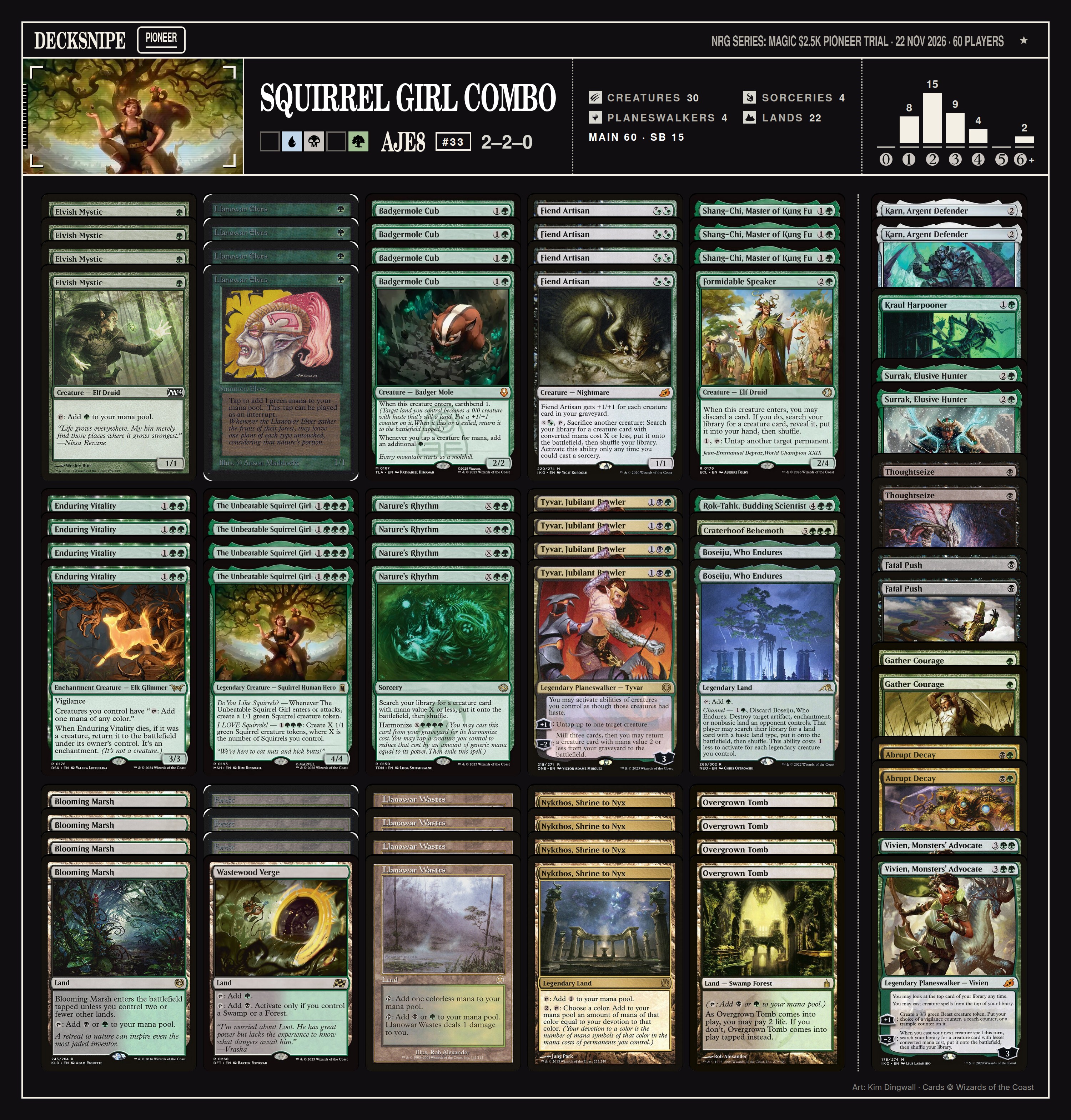
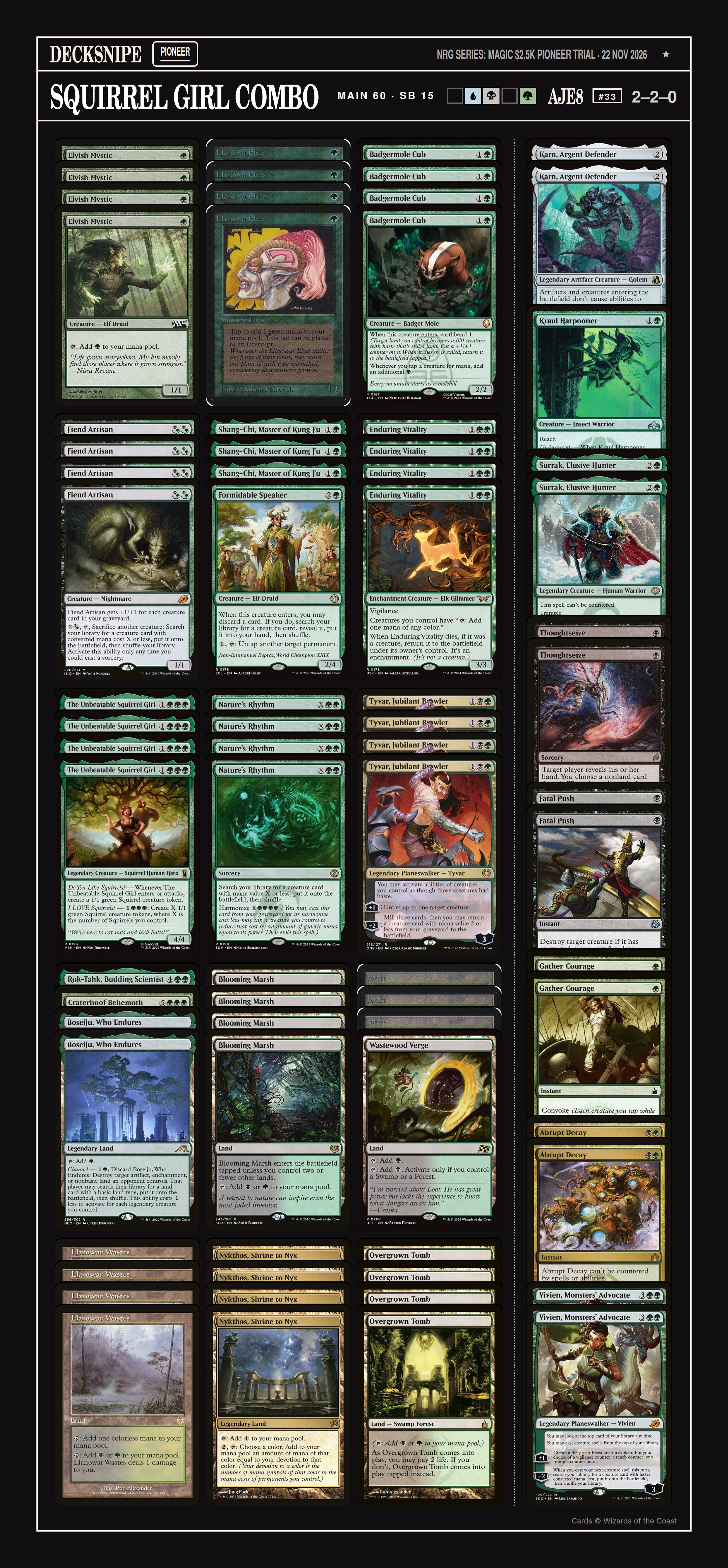
Maindeck (60)
Creatures 30
Sorceries 4
Planeswalkers 4
Lands 22
Sideboard (15)
75 cards
Show decklist for TurnPikeBear
Squirrel Girl Combo
Open at tournamentDownloadImageWideTall
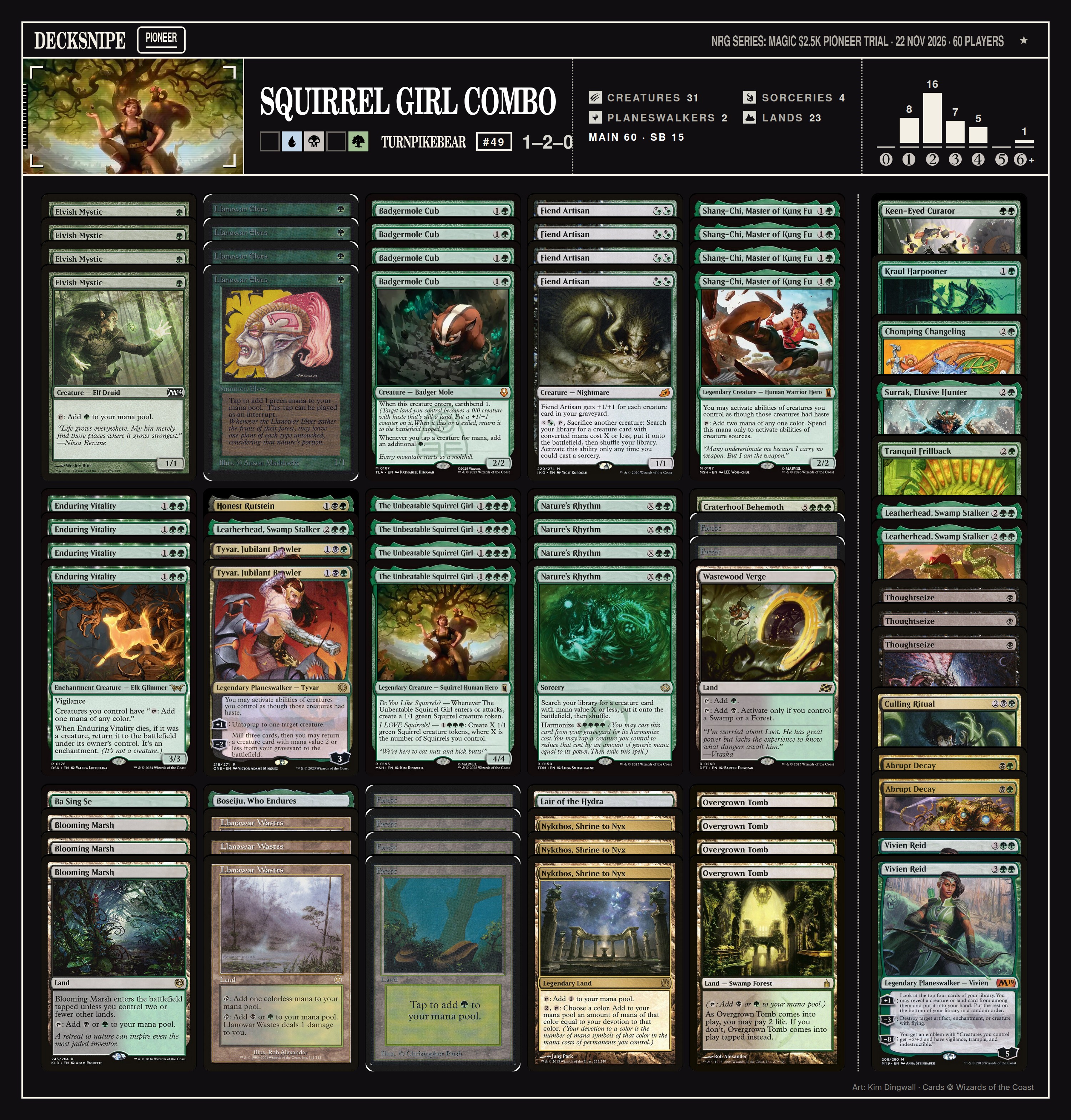
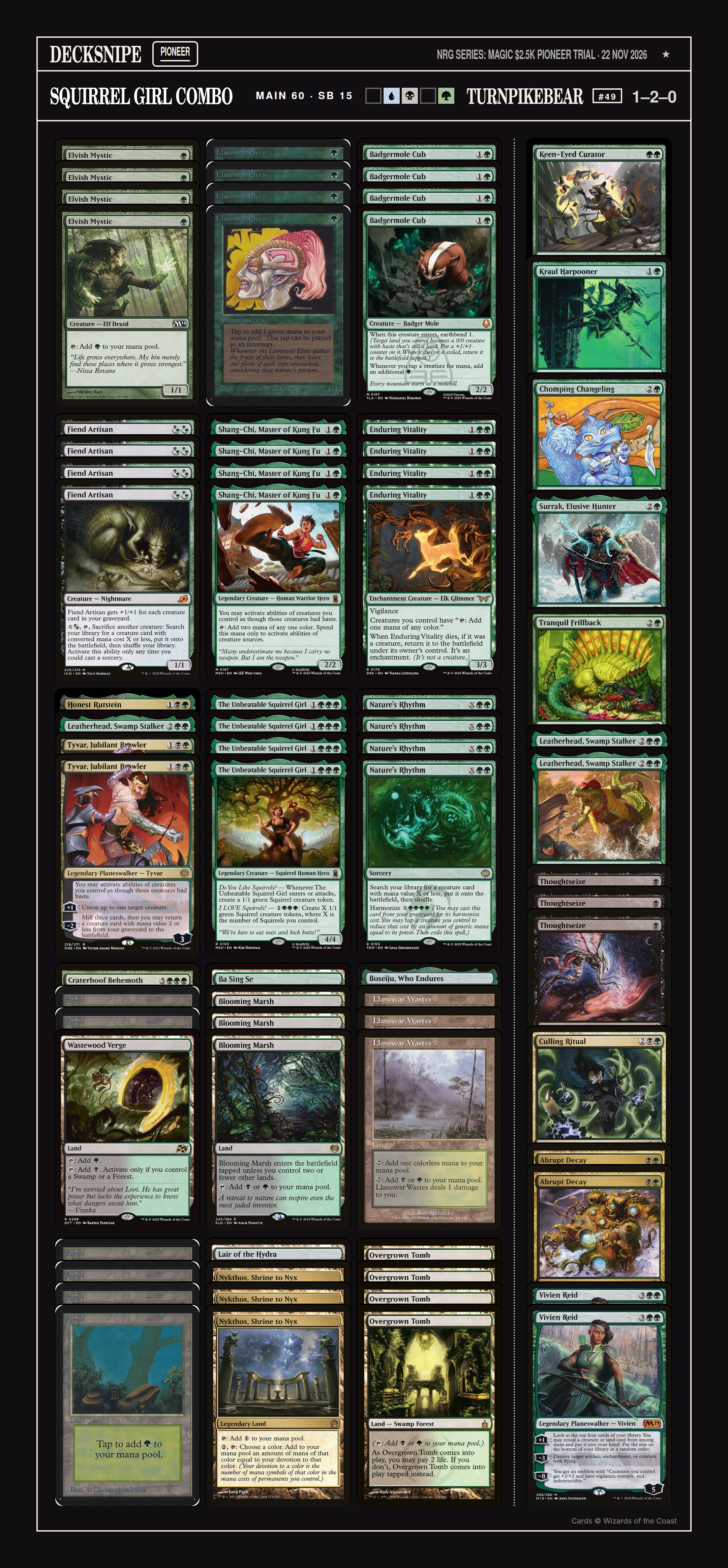
Maindeck (60)
Creatures 31
Sorceries 4
Planeswalkers 2
Lands 23
Sideboard (15)
75 cards
Show decklist for CliffBoyardee
Squirrel Girl Combo
Open at tournamentOpen at playerDownloadImageWideTall
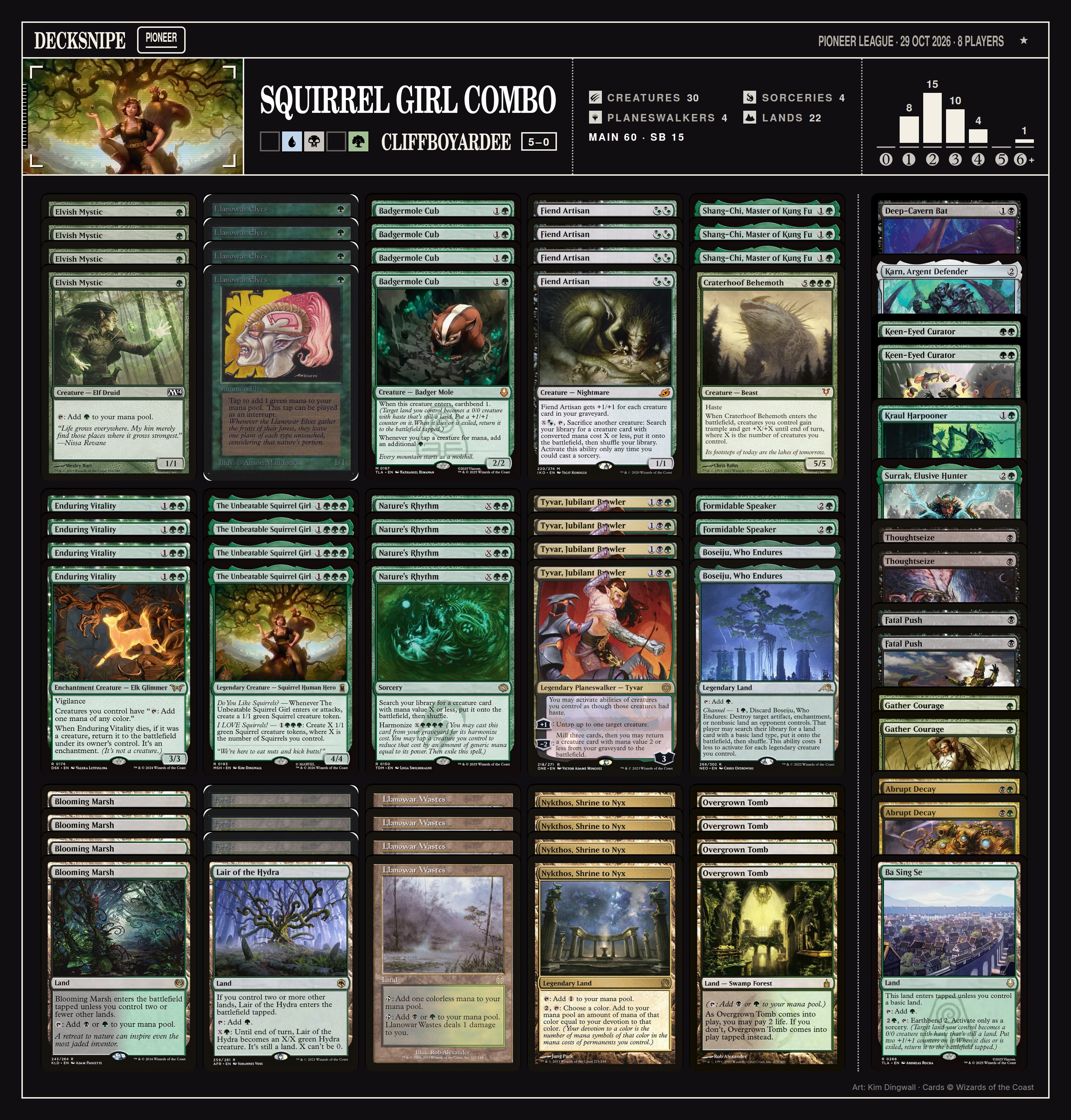
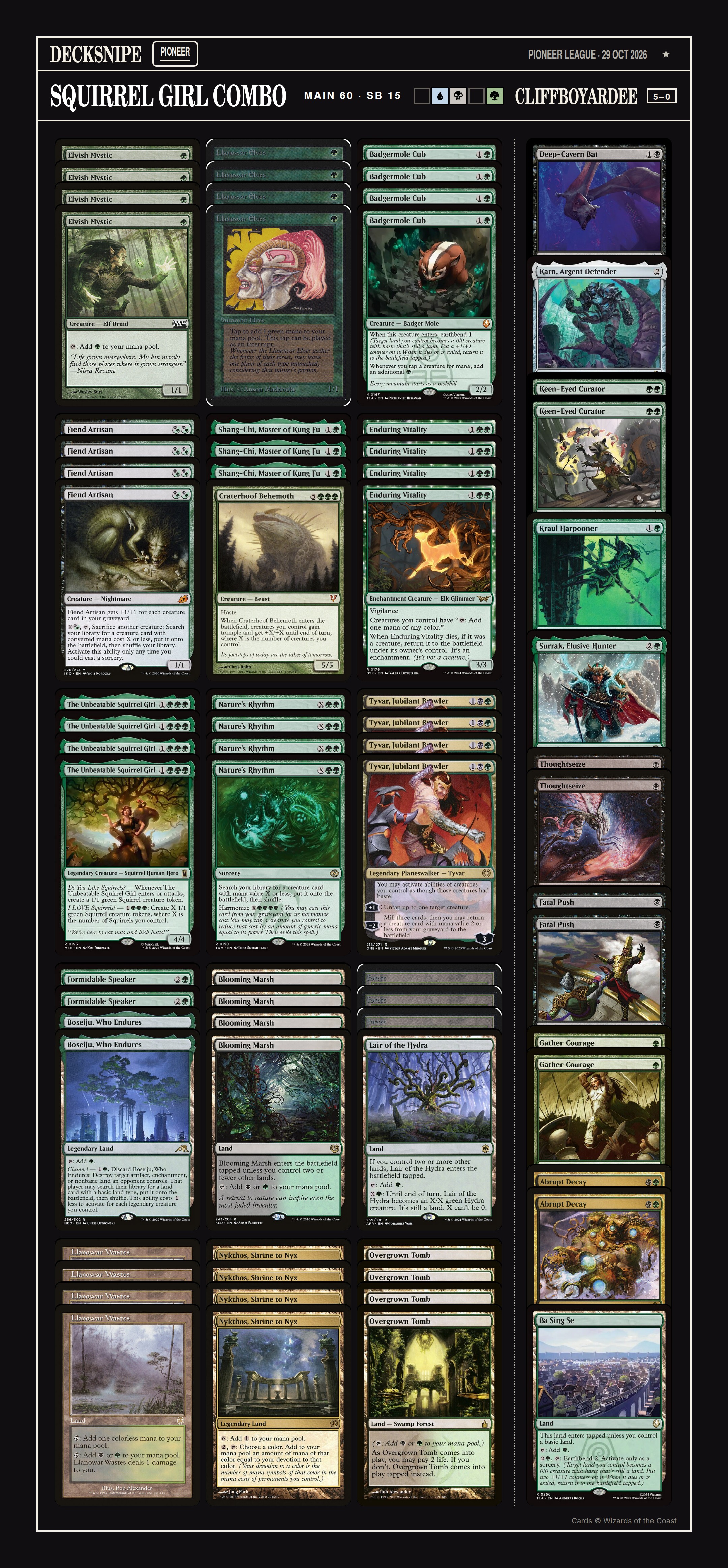
Maindeck (60)
Creatures 30
Sorceries 4
Planeswalkers 4
Lands 22
Sideboard (15)
75 cards
Decklist
PuffSun, #17, NRG Series: Magic $2.5k Pioneer Trial
Who plays it
MTGO, this window
| Player | Record | Win rate | Results |
|---|---|---|---|
| CliffBoyardee | No matches | 1 League 5–0 |
MethodHow these numbers are made
- A slot is one card in the average list. For each card, we count the lists that play at least one copy, then at least two, and so on. We add those shares. Add every card and the boards total 60 and 15.
- The settled bound is chosen at 80% of published lists. Settled slots are solid. The others are hatched. Cards in fewer than 10% of lists still count in the argued-over total, but their rows are not shown.
- The band bounds are chosen. Locked starts at 60 settled slots out of 75. Consolidated starts at 50. Debated starts at 40. Open is below 40. A locked deck is not a better deck.
- Share is share of published decklists, not of the field. Each list counts once, paper or MTGO. No platform and no event is weighted. An Arena event we add by hand counts here too.
- The two platforms publish different lists. A paper event on Melee publishes almost every player's list. An MTGO Challenge publishes 32 lists, whatever its size, and those lists lean to the top of the standings. So paper and MTGO together mix almost the whole paper field with MTGO's top finishers. One big paper event can be a large part of a window. Pick MTGO or Paper to see one platform alone.
- Leagues publish 5–0 decklists and no match data. Deck counts and shares count them, because a registered list is a registered list. Win rates cannot, because a League has no matches. So counts and shares cover all published decklists, and win rates cover events with match data only.
- Preliminaries contribute nothing. They publish match records but no decklists, so their matches have no archetype to attach to.
- Win rates count only matches where both players published a decklist. With both sides counted, every win has a matching loss, so the pool always balances at exactly 50% wins. Mirror matches (the same archetype on both sides) are left out.
- On paper, almost every match has both lists, so a paper win rate measures a deck against the whole field. On MTGO, the published lists are the top finishers, so an MTGO win rate measures a deck among the top finishers. Paper and MTGO together mix the two.